Our Diaries, Ourselves
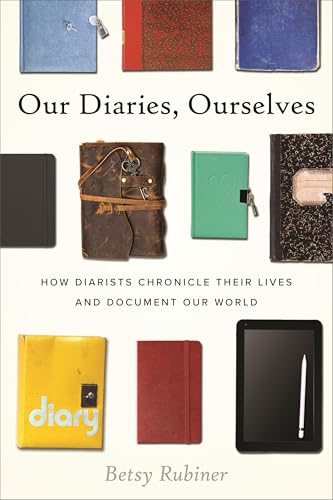
Our Diaries, Ourselves: How Diarists Chronicle Their Lives and Document Our World
On blogging:
During the early blogosphere boom, blogging was very social, with people writing for themselves and like-minded others, reading and commenting on each other’s posts. To share their diaristic posts with a limited group, bloggers joined early online diary communities (such as OpenDiary.com and Myspace.com) and aggregator sites (such as LiveJournal.com and Diarist.net). These early online diaries were “both private and public, both inward and outward-looking,” writes Lena Buford, a University of Pennsylvania administrator who was an early blogger.
By 2004, Merriam-Webster’s Word of the Year was blog, defined as “a Web site that contains an online personal journal with reflections, comments and often hyperlinks.” At the same time, blogs became commercial, used for corporate branding and marketing, luring visitors to websites for Nike, Sprint, and Boeing.
— p.23
tickled by this definition of blog that highlights comments (I don’t have them; quite a complicated feature) and hyperlinks (in contrast to social media networks like Instagram that are anti-hyperlink).
“Diary” as gendered:
Such is the “gender paradox” of diary literary history, reports diary scholar Desirée Henderson: “The most celebrated and canonical diaries are those written by men but the genre as a whole is characterized as feminine.” Male diarists are credited with establishing the diary’s conventions and perfecting its aesthetics, even though diaries are thought to appeal more to women.
— p.38
On diaries of ordinary people:
Diary archives, although not typically government run, preserve a nation’s heritage and culture by bolstering its sense of self, distinctive traditions, and shared history, writes Dutch historian Marijke Huisman. The archives also “empower and immortalize common people.” In a 2016 journal article about diary archives in the Netherlands, Germany, France, and Italy, Huisman wrote that “they appear to fulfill an almost existential need: to save the common man and woman from oblivion through the elevation of their life narratives into national heritage and memory.” (Some archives call their effort a “memory project.” Italy’s annual gathering has been billed as “a festival of memory.”)
— p.152
related thread in the novel I Who Have Never Known Men which I had just read earlier this week:
I realised then that I never thought about the past. I lived in a perpetual present and I was gradually forgetting my story. At first, I shrugged, telling myself that it would be no great loss, since nothing had happened to me, but soon I was shocked by that thought. After all, if I was a human being, my story was as important as that of King Lear or of Prince Hamlet that William Shakespeare had taken the trouble to relate in detail.
On “metadata”:
From diary scholars, I have learned to pay attention to a diary’s “materiality” and physical details: the writing materials used, changes in handwriting, blank pages, doodles, and the “paratext,” pre-printed supplementary material found in manufactured diaries that hint at the particulars and passions of the diarist’s day.
— p.182
What’s the digital equivalent? I suppose things like: the blog design (perhaps there should be a way of reading a blog post as it had appeared at that point in time, instead of a universal site redesign…) or social network syndication (what platforms do you share on?)… what else?